How Many Layers of Silage Film Do You Need? 4, 6, 8 Layer Guide
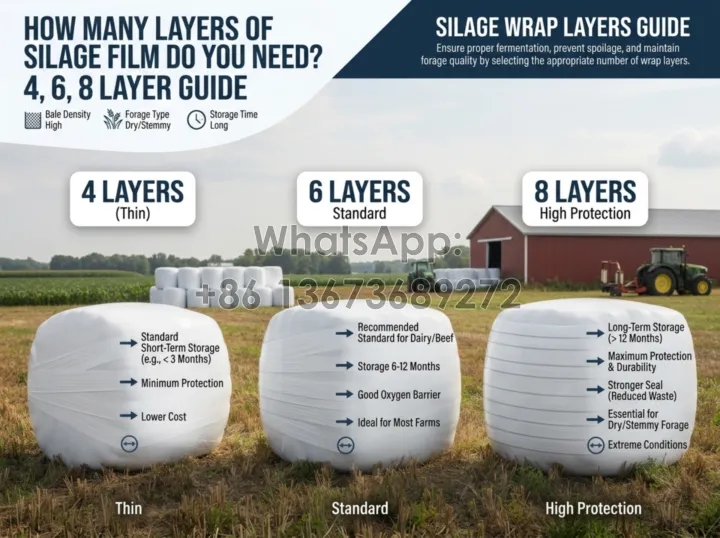
How many layers of silage film do you need? For most round silage bales, 6 layers of 25 µm stretch film applied at 50% pre-stretch is the industry standard. Use 4 layers for short-term corn silage consumed within 6 months, and 8 layers for high-moisture haylage or bales stored 18–24 months. Layer count affects oxygen barrier, UV protection, and bale shelf life far more than film thickness alone. The 4QM-1200 Silagewickler lets operators dial in 4, 6, or 8 layers on the control panel and apply them with two 500 mm film rolls simultaneously.
This guide covers layer selection by forage type, the math behind pre-stretch, film consumption per bale, and common mistakes that lead to spoiled silage.
Quick Answer: Layers by Use Case
| Layers | Beste für | Maximum Storage | Film per Bale (Φ1000×850 mm) |
|---|---|---|---|
| 4 layers | Short-term corn silage, dry climate, fast feed-out | 6 months | ~0.30 kg |
| 6 layers | Standard corn silage, mixed forage, most farm operations | 12 Monate | ~0.45 kg |
| 8 layers | High-moisture haylage (>65% moisture), long-term storage, sharp or stemmy forage | 18–24 months | ~0.60 kg |
Why Layer Count Matters More Than Film Thickness
Each layer of stretch film creates an additional oxygen and moisture barrier. Doubling the layers from 4 to 8 cuts oxygen transmission roughly in half and adds puncture resistance. Upgrading from 25 µm to 30 µm film only improves barrier by 15–20%, while adding 2 layers improves it by ~45%. For most buyers, more layers at 25 µm outperform fewer layers at thicker gauges—and the per-bale cost is similar.
Three things determine the right layer count for your operation:
- Moisture at baling. Wet forage (>65%) ferments aggressively and produces more CO₂ during the early aerobic phase. More layers prevent oxygen ingress during that critical first 21 days.
- Storage duration. Every additional month in storage adds risk of UV degradation and physical film damage. Long-stored bales need extra layers to compensate.
- Forage texture. Stemmy or sharp crops (sorghum, mature alfalfa) can puncture film during handling. More layers give a thicker mechanical buffer.
Layer Recommendations by Forage Type
| Grundfutter | Ziel Feuchte | Recommended Layers | Warum |
|---|---|---|---|
| Whole-plant corn silage | 60–70% | 4–6 | Standard; 4 for fast feed-out, 6 for >6 month storage |
| Alfalfa haylage | 50–60% | 6–8 | High protein + buffer capacity; needs airtight seal |
| Sorghum / millet silage | 60–70% | 4–6 | Lower sugar than corn; standard sealing |
| Hafer Heulage | 50–60% | 6 | Fine stems puncture easily; mid-range layer count |
| Mixed Gras– legume | 50–65% | 6 | General-purpose recommendation |
| High-moisture brewers grains | 65–75% | 8 | Very wet; aggressive fermentation needs strong barrier |
| Dry hay (baleage, <50% moisture) | 40–50% | 4 | Low fermentation; minimal barrier required |
How Pre-Stretch Affects Layer Count
Pre-stretch is the percentage the film is stretched during application. Most modern silage wrappers run at 50% pre-stretch—a 1-meter length of film becomes 1.5 meters when applied to the bale. Stretching the film thins it from 25 µm to roughly 17 µm in the stretched zone while improving cling and conformity around the bale.
Two implications for layer count:
- Pre-stretched film uses less material. At 50% pre-stretch, a 1500 m roll of 500 mm × 25 µm film covers about 60–80 bales at 6 layers, vs. 40–55 bales at 0% pre-stretch.
- Pre-stretch must be calibrated. Over-stretched film (60%+) tears easily; under-stretched film (≤30%) loses cling and seal quality. The 4QM-1200’s pre-stretch gears are factory-set to 50%; replace them as a pair if you see film tearing at the dispenser.
Film Consumption and Cost per Bale
For a Φ1000 × 850 mm round bale (Φ1000 mm diameter, 850 mm height, ~400–500 kg), the math works out to roughly:
| Layers | Film per Bale (kg) | Meters per Bale | Cost per Bale (USD, 25 µm, 500 mm) |
|---|---|---|---|
| 4 | 0.30 | ~17 m | ~$0.45 |
| 6 | 0.45 | ~25 m | ~$0.68 |
| 8 | 0.60 | ~33 m | ~$0.90 |
Cost per bale is small—under USD 1 even at 8 layers—but film represents the highest variable cost in silage wrapping. Choosing the right layer count is more about preserving forage value than saving film.
Common Layer-Count Mistakes
- Using 4 layers for 12-month storage. A 4-layer bale stored through a hot summer typically develops surface mold by month 8. The lost forage value far exceeds the film cost of going to 6 layers.
- Counting layers visually. A “4-layer” bale with poor overlap (≤40%) is effectively 2.5 layers in some zones. Keep film overlap at 50% and inspect the finished bale for bare patches.
- Stacking bales too high. Even 8-layer bales fail if stacked 3+ high. The bottom layer compresses and film can split. Limit stacks to 2 bales high.
- Skipping the end caps. Most wrappers apply film side-to-side; the flat ends of the bale need extra coverage. The 4QM-1200’s double-roll design covers the ends faster, but always inspect the cap zone for gaps.
FAQs on Silage Film Layers
Is 4 layers of silage film enough?
4 layers is enough for short-term corn silage stored less than 6 months in a dry climate. For longer storage or wetter forages, use 6 or 8 layers.
Is 6 layers of silage film good?
Yes—6 layers at 50% pre-stretch is the industry standard for round silage bales stored up to 12 months. It balances seal integrity, film cost, and wrap time.
When should I use 8 layers of silage film?
Use 8 layers for high-moisture haylage (above 65% moisture), stemmy or sharp forages prone to puncturing film, and any bale you plan to store 18–24 months.
Do more layers of silage film make better silage?
More layers improve the oxygen barrier and reduce spoilage on the bale surface. Going from 4 to 6 layers cuts oxygen transmission by roughly a third and is the most cost-effective upgrade for most operations.
How much film does one bale use at 6 layers?
At 6 layers, 50% pre-stretch, and a Φ1000×850 mm round bale, you use about 0.45 kg or 25 m of 500 mm×25 µm film. A standard 1500 m roll wraps about 60 bales.
Apply the Right Layer Count with the 4QM-1200
Der 4QM-1200 Silagewickler applies 4, 6, or 8 layers of 500 mm stretch film on a programmable control panel. Two film rolls run simultaneously to halve wrap time and seal the bale uniformly. The wrapper mounts on a standard 3-point hitch, requires a 90 HP tractor, and is compatible with all common round bale sizes (Φ900–1100 mm, ≤500 kg). Pair it with a Silagepresse oder 9YDB-100 Heulage-Ballenpresse for a complete cut → bale → wrap line. Factory pricing: USD 3,500–5,800 FOB. WhatsApp: +86 136 7368 9272 · E-Mail: info@taizyagromachine.com.