How to Start a Rice Mill Business: 15TPD Plant Cost & ROI Guide
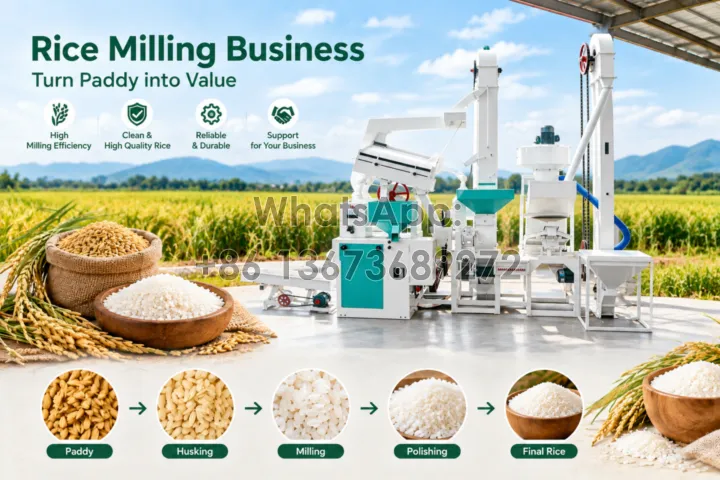
A Planta do moinho de arroz 15TPD is the standard entry capacity for a rice mill business: it processes 15 tons of paddy per day (600-800 kg/h), achieves a milling recovery rate of 68-72%, keeps the broken rate under 2%, and runs on a total power load of only 23.3 kW. At that capacity, one shift converts roughly 15 tons of paddy into about 10 tons of white rice plus marketable by-products—which is enough volume to serve a district-level market, a cooperative, or a toll-milling operation while keeping the investment small enough to recover within the first 1-2 years.
Based on the Taizy MCTP15 rice mill plant delivered to Nigeria, Ghana, Kenya, Côte d’Ivoire, Burkina Faso, Peru and Cuba, this guide walks through the machine list, cost structure, an ROI calculation model you can run with your own local prices, and the practical steps from site preparation to your first sales contract. All equipment figures below are real specifications; all monetary examples are clearly marked as illustrative.
Why 15TPD Is the Standard Entry Capacity
“TPD” means tons per day of paddy input. A 15TPD line equals roughly 0.6-0.8 tons per hour—small enough to install in a 100 m² workshop with a single electrician’s three-phase supply, yet large enough to buy paddy from 20-50 smallholder farmers per day instead of hand-to-mouth volumes that never cover overhead.
| Daily throughput (1 shift) | Produção | What it means for your business |
|---|---|---|
| 15 t paddy milled | ≈10-11 t white rice (68-72% milling rate) | 500 g retail packs: ≈20,000 bags/day |
| By-products | ≈2.5-3 t husk, bran & broken rice | Sell to feed mills, breweries, fuel and bedding markets |
| Annual (25 days × 12 months, one shift) | ≈4,500 t paddy → ≈3,150 t white rice | Enough to supply one district market or a supermarket contract |
Compared with a single small rice milling machine, the integrated plant adds three things that decide profitability: a rubber-roller husker (less breakage), a gravity paddy separator (recycles unhusked paddy instead of losing it into the rice stream), and a grader (separates sellable broken rice cleanly). That combination is what pushes the recovery rate to 68-72% at ≤2% broken—see the full rice mill process explained here.
Equipment Included in a 15TPD Plant
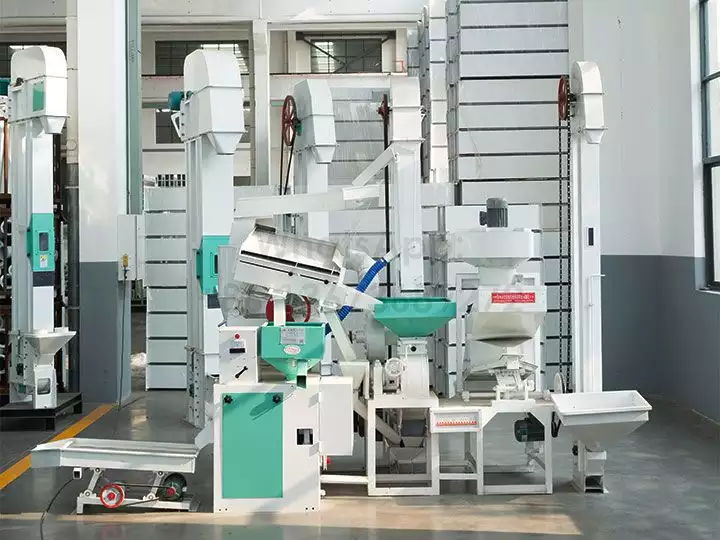
This is the actual machine list of the Taizy MCTP15 basic configuration, with real model numbers and power ratings:
| Etapa | Máquina | Modelo | Poder | Função |
|---|---|---|---|---|
| 1 | Paddy destoner | ZQS50 | 0.75 + 0.75 kW | Remove stones, soil, straw and fine sand before milling |
| 2 | Descascador de arroz | LG15 (6-inch rubber rollers) | 4 kW | Peel the outer husk to get brown rice with minimal breakage |
| 3 | Separador de arroz por gravidade | MGC270×5 | 0.75 kW | Separates brown rice from unhusked paddy by gravity and surface friction; paddy returns for re-hulling |
| 4 | Máquina de moagem de arroz | NS150 (emery roller) | 15 kW | Removes the brown bran layer to produce white rice |
| 5 | Classificador de arroz | Type 40 | 0.55 kW | Screens whole grains from broken rice |
| — | Elevators ×2 | TDTG18/07 | 0.75 kW each | Vertical conveying between stages, eliminating manual handling |
| Total | MCTP15 | 23.3 kW | 15 t/day | 1,400 kg weight · 3×3×3 m layout · 8.5 cbm packing (1×20GP container) |
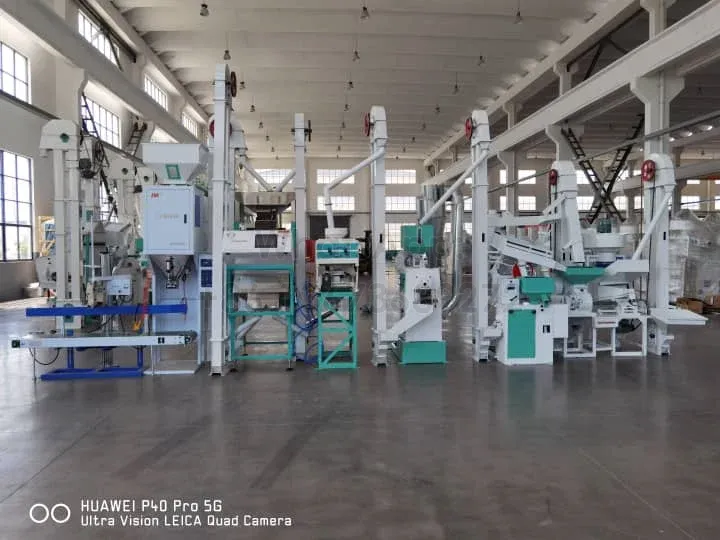
If you plan to sell branded premium rice rather than wholesale, choose the 15tpd Planta de moagem de arroz completa (MCTP15-A / -B / -C configurations), which adds rice polishing, color sorting and automatic weighing & packing—the with-package version covers the packing stage. The working video below shows the basic unit running:
Cost Structure: What You Actually Pay For
Equipment is only one line in the budget. A realistic start-up plan for a 15TPD rice mill business covers five cost blocks. The ranges below are industry reference estimates for emerging markets, not Taizy quotations—request a configuration-specific quote for the equipment figures:
| Cost block | Illustrative range (USD) | Notas |
|---|---|---|
| Equipment — basic line (MCTP15) | 15,000 – 25,000 | Ref. estimate; final price follows capacity, configuration and automation. Get a quote |
| Equipment — complete line (polisher + color sorter + packer) | 30,000 – 55,000 | Ref. estimate; needed for branded retail rice |
| Building & foundation | Usually 20-40% of equipment cost | ≈100-200 m² workshop + 300-500 m² paddy warehouse; simple steel shed works |
| Power installation | Transformer/connection varies by grid | 23.3 kW total load; size the supply at ~30 kVA with starting margin |
| Paddy working capital | The single biggest number | 1-2 months of paddy stock; this is what most first-time operators underestimate |
| Wear parts reserve | 3-5% of equipment cost per year | Rubber rolls (6-12 months), emery rings, screens, belts, elevator buckets |
Ask yourself the sourcing question before the machine question: can you buy 15 tons of paddy per day at a stable price, 200+ days a year? Plants near production zones (Nigeria’s inland valley swamps, Ghana’s Ashanti belt, Kenya’s Mwea, the Mekong delta) clear this hurdle easily; import-repacking economies need a different model. Two harvest seasons per year in tropical zones also mean you can bank six months of margin in three months of grinding.
ROI Model: How the Money Comes Back
A rice mill earns in three stacks. Run your own local prices through this model (example prices, clearly illustrative):
| Revenue stack | Example basis (per day, 15 t paddy) | Example value (USD) |
|---|---|---|
| 1. Trader margin — buy paddy, sell rice | Paddy bought at 380/t; 10.5 t rice sold at 590/t; by-products 20/t | Gross ≈ 4,900/day before processing cost |
| 2. Toll milling margin — process for others | Fee 30-50/t of paddy milled | 450-750/day at 15 t |
| 3. By-products | Husk to fuel/bedding, bran to feed mills, broken to breweries | Often covers the day’s electricity bill |
Processing cost is what the margin survives: power at 23.3 kW × 8-10 h ≈ 200-240 kWh/day, 2-4 operators, and wear parts—call it USD 25-45 per ton of paddy milled in most markets. The break-even formula is simply:
Break-even tons of paddy / month = monthly fixed costs ÷ (margin per ton paddy milled − variable processing cost per ton)
With a trader margin of USD 60-120 per ton of paddy processed (example), a plant running two shifts (30 t/day, 600 t/month) generates USD 36,000-72,000 gross margin per month before overhead. In real deliveries, operators commonly recover the basic-line equipment cost within 8-18 months of stable operation; the complete line takes longer but earns a retail-brand premium of 10-25% per bag instead of wholesale pricing. Both paths depend on one variable you control: the milling recovery rate. At 70% instead of 65%, every 1,000 t of paddy yields 50 extra tons of saleable rice—often the whole annual profit.
Space, Power & Staffing Requirements
- Main unit footprint: the MCTP15 integrates into a 3×3×3 m layout (1,400 kg total weight)—allow 100-200 m² of workshop for flow, infeed hops and bagged output.
- Alimentar: 23.3 kW total connected load. Plan a ~30 kVA supply or a diesel generator set for unstable grids; less power consumption per ton is one of this model’s design points.
- Staffing: 1 operator at the controls + 2-3 for bagging, infeed and forklift/wheelbarrow work. A family-run plant typically staffs 2-4 people.
- Logistics: the whole plant ships in 8.5 cbm—a single 20GP container. Installation guidance, operator training and remote technical support come with the equipment.
7 Steps to Start, in Order
- Test your paddy supply, not your demand. Visit 10-20 farmgate or aggregator dealers in a 50 km radius and price paddy at 13-14% moisture across both seasons. Your mill’s profitability is bought in the field, not in the factory.
- Choose the business model: trader (buy paddy / sell rice), toll miller (fee per ton), or hybrid—60% of small plants in West Africa run hybrid to keep the line busy in the lean months.
- Secure site and power (see requirements above) before ordering, so installation doesn’t stall after arrival.
- Select the configuration. Basic Planta do moinho de arroz 15TPD for wholesale rice; completo arroz moagem unidade with polisher, color sorter and packer for branded retail. Plan your upgrade path to 20TPD or 30TPD capacity when a second shift runs steady.
- Register and license. Food-processing registration and weights-measures certification gate your access to supermarket and institutional buyers; start early, in parallel with shipping.
- Commission with your own acceptance test: run 5 tons of your own paddy and measure the milling recovery rate and broken rate against the contract figures (68-72% / ≤2%). This one test protects every future margin calculation.
- Lock first sales before first production. A standing order from one wholesaler at 3 tons/week de-risks the working-capital cycle more than any advertising.
Risks Worth Planning For
- Paddy moisture and seasonality: buy a moisture meter on day one; wet paddy above 15% drops recovery rate and clogs screens. Price across the year and store accordingly.
- Roller and screen wear: husker rubber rolls drift out of gap tolerance quietly—broken rate rises before anyone notices. Keep a 6-month wear-part stock on site.
- Power interruptions: half-filled machines trip and jam; a stabilizer or genset with proper sizing protects throughput and quality alike.
- Underpricing by competitors: never sell below trader margin + processing cost to fill capacity; toll milling at a proper fee keeps the line busy instead.
FAQs About Starting a Rice Mill Business
How much does a 15TPD rice mill plant cost?
For the basic MCTP15 line, emerging-market reference estimates run USD 15,000-25,000, and USD 30,000-55,000 for a complete line with polisher, color sorter and packing machine. These are reference ranges, not quotations—final price depends on configuration and automation. Contact Taizy with your capacity and product plans for an exact quote.
Is a rice milling business profitable?
Yes, when paddy supply is stable and the recovery rate is protected. Typical gross margin structures combine a USD 60-120 per ton trader margin (example basis), toll-milling fees of USD 30-50 per ton, and by-product sales. Plants with reliable paddy sourcing commonly recover the basic-line equipment investment in 8-18 months.
How many tons of paddy make one ton of white rice?
At the MCTP15 milling recovery rate of 68-72%, about 1.4 tons of paddy yields 1 ton of milled rice. The remaining mass becomes husk (around 20%), bran and broken rice (around 10%)—all of which are saleable by-products, not waste.
What is the break-even point for a small rice mill?
Divide your monthly fixed costs (rent, salaries, connection fees, depreciation) by the net margin per ton of paddy milled. A typical 15TPD plant with USD 2,000-3,500 monthly fixed costs breaks even at roughly 40-80 tons of paddy per month—about 3-6 operating days at full capacity. Everything above that is margin, which is why paddy access matters more than capacity.
How many workers does a 15TPD rice mill need?
2-4 people: one machine operator plus 1-3 for infeed, bagging and loading. The two TDTG elevators remove most manual handling between stages, which is where labor savings come from versus standalone machines.
What additional equipment increases rice mill profits?
In order of payback speed: a moisture meter (protects buying price), a weighing and bagging scale (stops shrinkage), then a rice polisher and color sorter for premium-grade retail rice, and finally automatic packing with your own brand. The complete-line configurations add these in stages.
Can one rice mill line process both paddy and parboiled rice?
The hulling and milling stages handle both, but parboiled paddy needs an extra cooking-and-drying section upstream. If parboiled rice is your target market, tell your supplier at the quoting stage so the line is configured for it.
Next Step: Model Your Own Numbers
Send us your paddy purchase price, expected local rice price, and daily operating hours. We’ll run the three revenue stacks above against your figures, recommend the right MCTP15 configuration, and provide a layout drawing for your workshop—backed by installation guidance, operator training, and remote technical support.
WhatsApp: +86 136 7368 9272 · Email: info@taizyagromachine.com