Mechanized Nursery vs Traditional Methods: Which Is Better?
For decades, farmers and greenhouse operators relied on hand-seeding for seedling production. It works—but it comes with hidden costs. As operations grow, those costs become impossible to ignore.
This guide compares mechanized nursery vs traditional methods, showing exactly where the difference shows up in your time, labor, and bottom line.
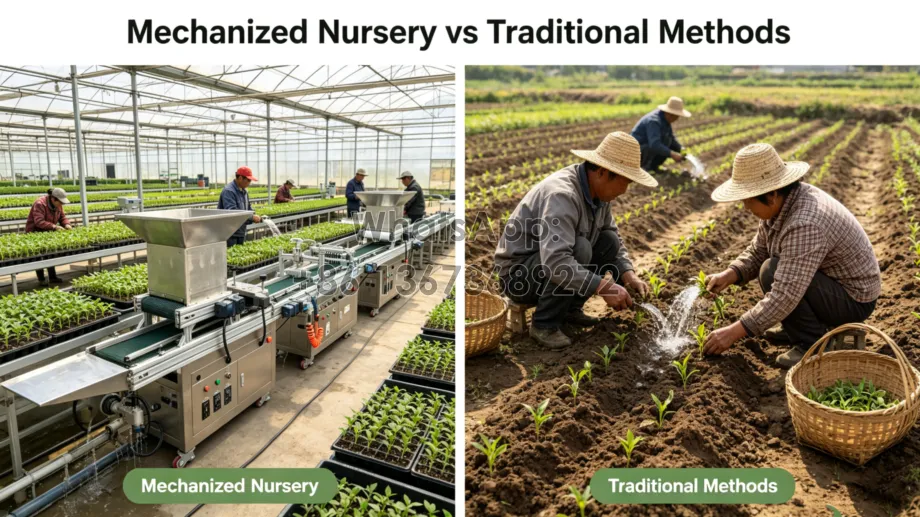
What Are Traditional Seedling Methods?
Traditional seedling production is a fully manual process:
- Tray filling: Workers fill trays with soil by hand
- Seed sowing: Seeds placed individually or scattered
- Covering: Thin soil layer added by hand
- Watering: Manual watering with a hose or watering can
- Germination: Trays moved to the germination area
This method works for small operations. The problems start when you scale up.
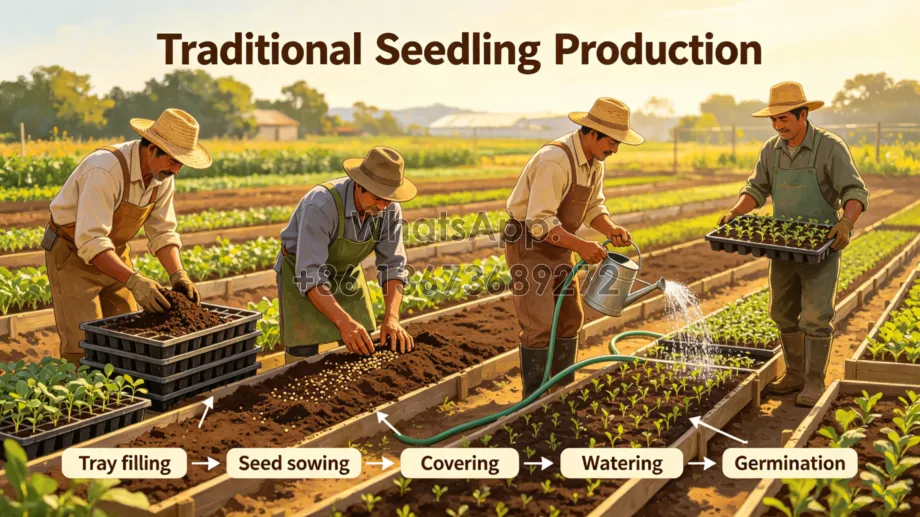
What Is Mechanized Nursery Production?
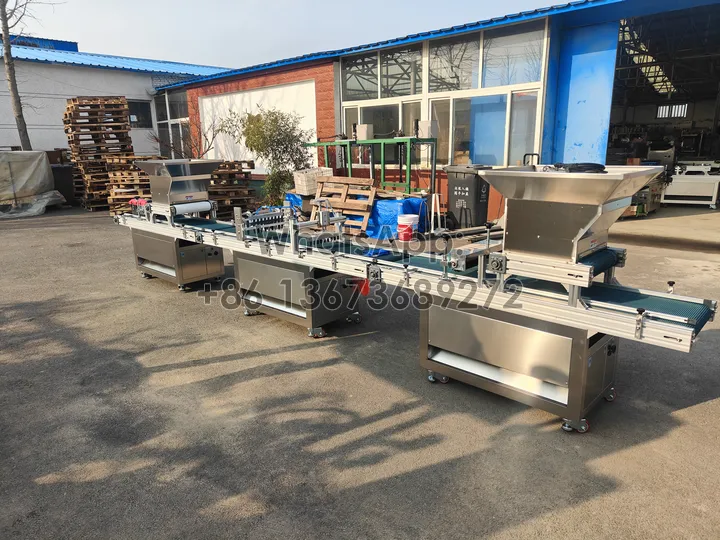
A mechanized nursery uses a seedling nursery machine to automate the process:
- Tray loading: Empty trays placed on the conveyor
- Automatic soil filling: Consistent fill density every time
- Precision seeding: Vacuum needles place seeds at exact depth and spacing
- Automatic watering: Integrated system ensures uniform moisture
- การเก็บรวบรวม: Finished trays ready for germination
The same process happens 5-10x faster with less labor.
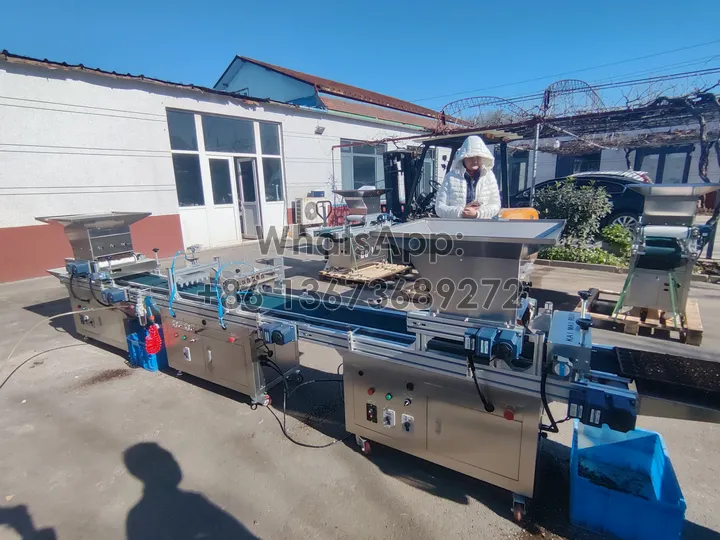
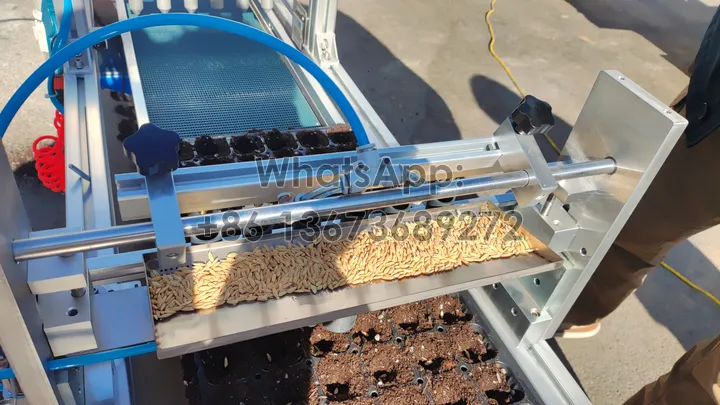
7 Core Advantages of Mechanized Nursery
| Advantage | Traditional | Mechanized Nursery |
| Speed | 60-80 trays/day per worker | 200-400 trays/hour per machine |
| Labor | 6 workers per operation | 2 operators per machine |
| Seed Saving | Seeds often wasted | Precision reduces waste by 30% |
| Uniformity | Variable tray quality | Consistent depth and spacing |
| Germination Rate | 70-80% typical | 90-95% typical |
| Worker Fatigue | High physical strain | Minimal physical work |
| Operating Cost | High long-term labor cost | One-time equipment investment |
Quantified Benefits
Here’s what changes when you switch to mechanized seedling production:
- Speed: 5x faster seeding
- Labor: 70% reduction in workforce needed
- Germination: 15-20% higher rates
- Seed waste: 30% reduction in seed consumption
For a mid-size greenhouse producing 500,000 seedlings annually, these gains translate to significant cost savings.
Who Should Switch to Mechanized Nursery?
| Operation Type | Why It Works |
| Small greenhouses (under 1 hectare) | Affordable compact models available |
| Mid-size operations (1-5 hectares) | Clear ROI within 1-2 seasons |
| Commercial growers (5+ hectares) | Essential for meeting volume demands |
Return on Investment on Mechanized Nursery & Traditional Methods
The numbers tell a clear story:
Traditional method cost per year:
- 6 workers × $400/ month × 12 months = $ 28,800
- Plus lost productivity and seed waste
Mechanized nursery cost per year:
- 2 operators × $400/ month × 12 months = $ 9,600
- Machine investment: ~$8,000 (one-time)
- Annual savings: $19,200+
Most operations recover their equipment investment within 1-2 production seasons.
Key Decision Factors of Nursery Seedling
Before switching, consider:
- Operation size: 100,000+ seedlings/year justifies mechanization
- Crop variety: Machines handle multiple seed sizes (typically 0.3-15mm)
- Available labor: High labor turnover makes mechanization more attractive
- Capital budget: Look for machines with payment plan options
- Workspace: Compact designs fit most greenhouse layouts
- Voltage and power: Match machine specs to local infrastructure (220V/110V)
5 Steps to Switch to Mechanized Nursery
- Assess: Calculate your current seeding volume and labor costs
- Research: Compare models with capacity matched to your needs
- Test: Ask for a nursery seeding machine demonstration or trial period
- Plan: Arrange workspace, power, and training
- Scale: Start with one machine, expand as you grow
The transition is straightforward. Most operators run their first batch within a week of installation.
FAQs
Is a mechanized nursery suitable for small farms?
Yes. Compact models (350-500kg) fit small greenhouses. The KMR-80-2 handles 200-400 trays/hour and works in tight spaces.
What seed sizes can a nursery tray seeder handle?
Most modern machines handle seeds from 0.3mm to 15mm, covering lettuce, tomato, pepper, cucumber, and most flower varieties.
How much does a seedling nursery machine cost?
Prices vary by capacity and features. Basic models start around $2,000-3,000; commercial units range $5,000-15,000.
How long does it take to learn the machine?
Most operators learn the basics in 1-2 days. Full proficiency comes within a week.
Can the machine work with different tray sizes?
Most models accept standard tray widths up to 300mm. Check specifications for your specific trays.
Related Products
- Seedling Nursery Machine – Browse our full range
- KMR-80-2 Nursery Tray Seeder – Our most popular model
- Transplanting Machine – Next step after seedling
- Greenhouse Equipment – Complete greenhouse solutions
Start Your Mechanization Journey
Still using traditional methods? A mechanized nursery setup pays for itself faster than most operators expect. Whether you run a small greenhouse or a commercial operation, we have a model that fits.
We provide equipment selection guidance, factory pricing, payment method support (L/C, T/T), worldwide shipping, and full after-sales service.